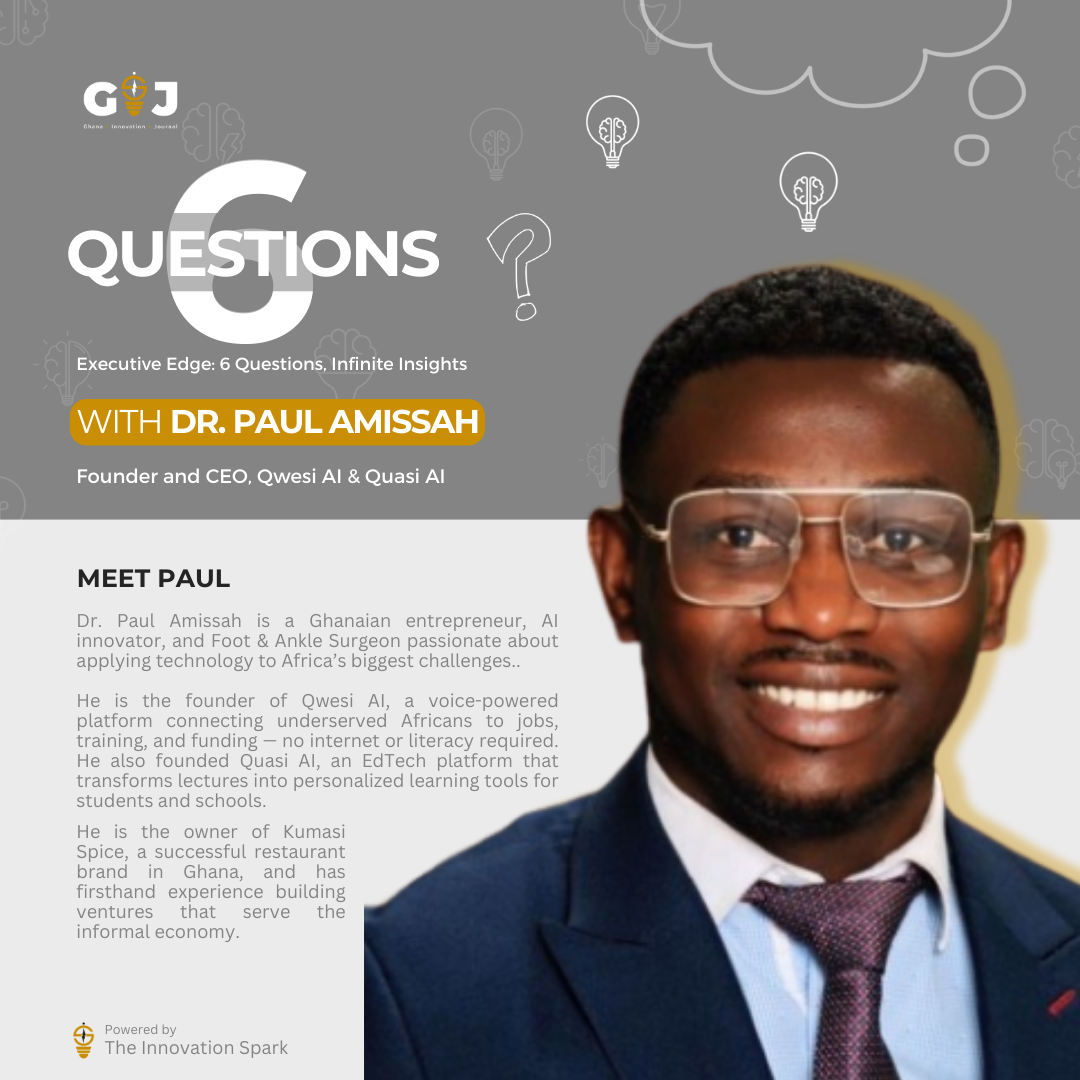
6 Questions is where we cut through the noise to spotlight the innovators reshaping Ghana’s future. In each edition, we go beyond the headlines to ask six pointed questions — about the ideas they’re testing, the risks they’re taking, and the impact they’re chasing.
For this edition, we sit down with Dr. Paul Amissah — a surgeon who’s just as comfortable in the operating room as he is building AI platforms and running restaurants. From Qwesi AI, which uses voice tech to connect underserved Africans to jobs and funding, to Quasi AI, an EdTech tool transforming how students learn, to his restaurant venture Kumasi Spice, Dr. Amissah is proving that innovation can be both high-tech and deeply grounded in everyday community needs.
How would you describe your job or startup to a 5-year-old?


I help people find jobs and get access to investors. We have created an AI called Qwesi, who sounds just like a human. All you need is a phone to call him and talk to him. Qwesi will soon be able to communicate in other languages. What we do is to fill Qwesi’s database with jobs and investors so when someone calls, he can easily connect them. Not just that, Qwesi can help you with your homework and other things.
What’s the most surprising thing you’ve learned since launching your startup?
In Ghana and most countries, its all about whom you know. Unfortunately, if you are not in the top 1% of the population, you stand no chance. We are paying the price to get access to the affluent, celebrities and connect people who have no chance at meeting them. A lot of people have money to invest but with lack of access to quality startups with real solutions, they are unable to invest. We are here to drive startup-investor relationships and help create more jobs in the African continent.
What’s one function or area of your job you spend most time on?
Talking to employers and investors. The more connections we can make, the more we can add to our database and the easier it will be to connect people to jobs and investors.
What are the 3 trends in your sector that you are bullish on or keeping a close tab on and why?
Voice Tech and Multilingual AI Adoption in emerging markets: Voice AI is becoming more accurate, affordable, and adaptable for low-bandwidth, local-language contexts. This is crucial for regions like sub-Saharan Africa where literacy and connectivity gaps persist.
Digital Inclusion for the informal economy: Africa’s informal sector accounts for over 80% of employment, but most platforms still target digital elites. There’s a growing shift toward building accessible, inclusive tech that works offline and without literacy. We’re ahead of the curve by building for basic phones, voice, and SMS, giving us a first-mover advantage among the digitally invisible — a market too big to ignore.
Skill-Based hiring and micro-certification: Global hiring is shifting from “CVs and degrees” to skills and proof of capability, especially for youth and entry-level roles. Microlearning, upskilling, and non-traditional training are gaining traction. By integrating voice-guided training and matching users to jobs based on conversational skill assessments, Qwesi is aligned with the future of work — not its past.
What gaps or problems in the market are you building for?
Exclusion of non-digital, non-literate job seekers: Most job platforms (e.g., LinkedIn, Jobberman, Indeed) assume users are literate, tech-savvy, and online. This excludes millions of Africans with basic phones, no formal resumes, and limited education. A voice-first, multilingual platform that lets anyone call in and be matched to jobs, investors, or training — no app or internet needed.
Employers can’t efficiently reach informal talent: SMEs and local employers need workers, but can’t reach reliable talent beyond urban centers. Word-of-mouth hiring is slow, unstructured, and high-risk. A screened talent pool, voice-interviewed and scored by AI, accessible via dashboard — making informal hiring structured, searchable, and safer.
Skills Mismatch and No path to certification: Many job seekers lack formal credentials but have skills. There’s no scalable way to assess or upskill them in contextually relevant, mobile-friendly format. Integration of voice-guided micro-training + certification, enabling users to become “Qwesi Certified” and gain trust with employers.
No navigation system for opportunity: Informal workers don’t just need jobs — they need guidance. Most don’t know where to find training, capital, or grants. We providing a single-entry voice gateway that listens to user needs and routes them to jobs, training, funding, or support based on AI-driven classification.
If you were to build a new company, which historical or contemporary figure would you appoint to the board and why?
Dr James Mwangi- CEO of Equity Group (Kenya)
Dr. Mwangi transformed Equity Bank from a struggling microfinance institution into one of Africa’s largest and most inclusive banks — by betting on financial access for the underserved. He understands how to serve the “unbanked” much like Qwesi AI seeks to serve the “unemployed.” He would help shape Qwesi into not just a job platform, but a wider opportunity ecosystem. His legacy of inclusive innovation and pan-African reach aligns perfectly with our goals.