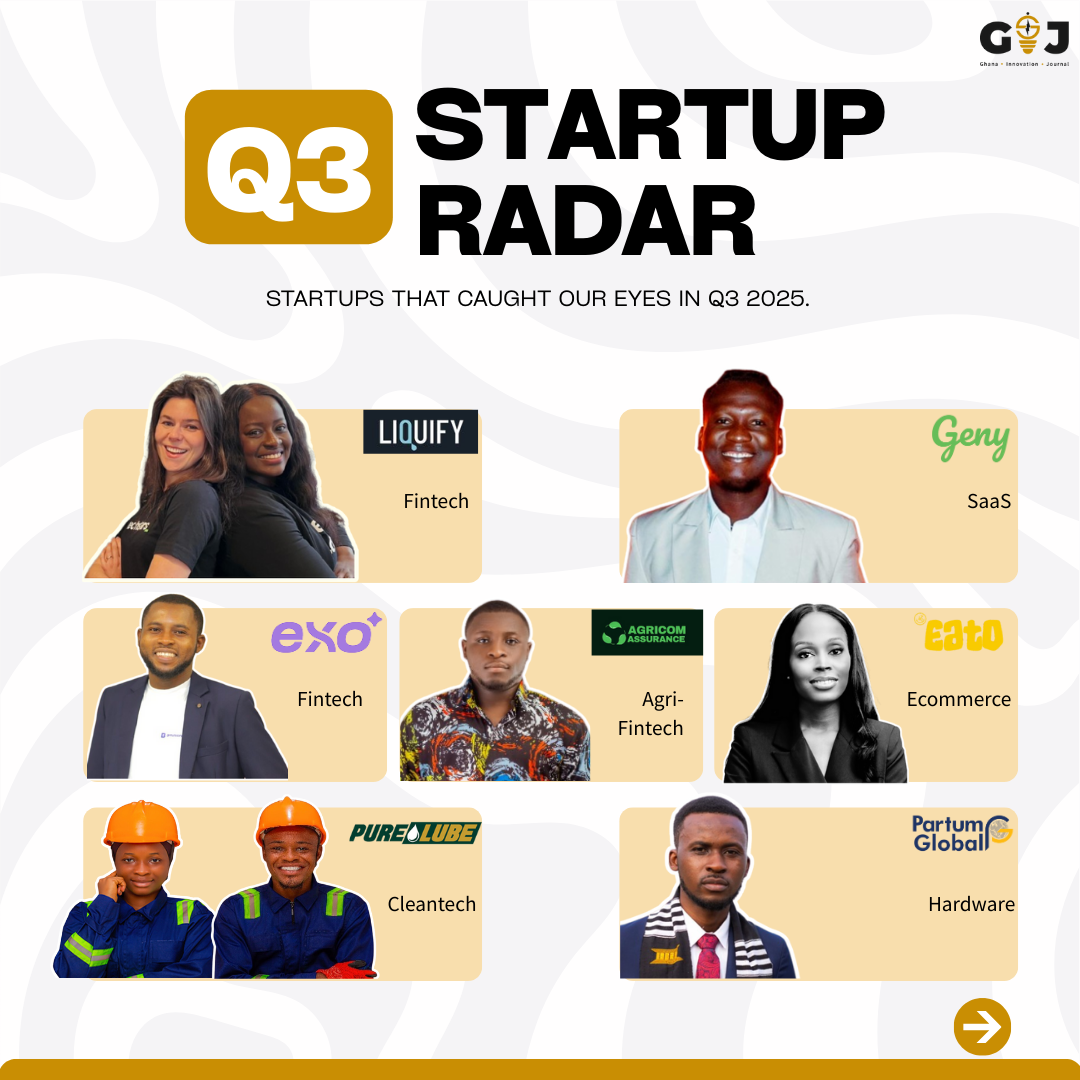
In Q3 2025, we profiled and engaged with over 20 startups through our This Week in StartupGhana newsletter. From AI-powered platforms to sustainable manufacturing, founders continued to identify pressing local problems and build tech-driven solutions. Across sectors like fintech, agritech, SaaS, and e-commerce, these startups are addressing gaps in access, efficiency, and sustainability.
Here’s a snapshot of the seven companies that impressed us most with their big ideas and sharp execution this quarter. The list is alphabetical and is not a ranking.
Agricom Assurance

The problem: In a country where agriculture underpins employment, smallholder farmers operate in a constant state of financial peril. The sheer unpredictability of climate change, disease, and volatile market prices means that a single bad season can wipe out a farmer’s livelihood, crippling capital investment and credit access. This isn’t just a farmer problem; it’s a structural risk to national food security.
The play: Agricom Assurance is tackling this systemic issue with tailored insurance. By moving beyond traditional policies to offer solutions like weather-index insurance and multi-peril crop coverage, they are creating a necessary layer of financial security. Their core innovation is translating massive, localized agricultural risk into manageable, investable data, making capital accessible and encouraging long-term sustainable farming practices.
EATO
The problem: African food culture is globally resonant, yet its digital presence is chaotic and fragmented. For chefs and entrepreneurs, scaling a concept—from local recipe to international brand—is severely hampered by a lack of digital standardization, quality infrastructure, and monetization tools. The market is huge, but the technology to aggregate it is missing.
The play: EATO is not a food delivery app; it’s building the foundational digital rails for African cuisine. Their platform is designed to empower chefs, food businesses, and content creators to standardize recipes, digitize their operations, and scale their brands globally. EATO’s recent funding signals that investors believe this platform is the missing piece required to turn Africa’s vibrant culinary heritage into a globally scalable, tech-enabled industry.
Exo AI
The problem: The average digital consumer is juggling too much. From savings and credit to investment and bill pay, the proliferation of fintech means users are forced to manage their money across roughly five different apps. This fragmentation is inefficient, confusing, and, crucially, prevents users from getting a holistic view of their finances.
The play: Exo AI is betting on a “One App to Rule All” agentic finance model. It connects all user accounts and uses AI to execute complex financial tasks from expense tracking to moving money and recommending products all via simple voice or text commands. It’s an assertive pivot away from passive data aggregation toward a truly active, conversational AI that acts as the user’s personal financial agent.
Geny AI
The problem: Skilled service professionals like plumbers, mechanics, or beauty therapists are literally hands-on all day. They are the backbone of the service economy, yet they lose valuable time and money to manual administrative work: scheduling, reminders, and payment chasing. They need an assistant, but their job makes using a phone difficult.
The play: Geny is solving this with a voice-first AI technology. By creating an assistant tailored for the trades, Geny allows professionals to manage their entire workflow like booking appointments, sending reminders, and collecting payments, entirely hands-free. This isn’t just automation; it’s a critical accessibility tool that unchains high-value workers from the desktop and directly translates to higher revenue and efficiency.
Liquify
The problem: African exporters are getting squeezed. They often face 90-day-plus payment cycles for international invoices, forcing them to turn to local financiers who charge exorbitant interest rates, sometimes hitting 30-40%. This working capital constraint is a growth killer, preventing even successful exporters from fulfilling larger orders.
The play: Liquify is a fully digital trade finance platform aggressively bridging this liquidity gap. The company’s core offering is invoice financing, paying exporters in under 24 hours at much fairer rates. By digitizing a traditionally complex, paper-heavy process, Liquify is transforming illiquid export receivables into an accessible asset class for financiers, effectively cutting out the high-cost middleman that was strangling African trade.
Partum Global
The problem: Off-the-shelf PCs force users into compromises: high-end gamers and video editors often pay for features they don’t need, while budget professionals are stuck with components that bottleneck their performance. The demand for highly specialized computing power for the creator economy is now too great for the generic supply chain to handle.
The play: Partum Global is a specialist in personalized computing, moving beyond mass-market products to build systems tailored component-by-component to the user’s exact needs and budget. By catering directly to the specific demands of gamers, content creators, and business professionals, they are capitalizing on the trend that sees hardware as a critical, customizable tool rather than a disposable commodity.
PureLube
The problem: Industry reliance on imported industrial lubricants is a sustainability and cost liability. Furthermore, the Cashew Nut Shell Liquid (CNSL), a significant local agricultural waste product, represents a missed economic and environmental opportunity. The market desperately needs a local, high-quality, and eco-conscious alternative.
The play: PureLube is using a brilliant “waste-to-value” model to be Ghana’s first eco-friendly lubricant brand. By creating high-quality grease from CNSL, they are simultaneously solving a waste problem, creating a local, affordable product, and mitigating supply chain risk. Their recent $15,000 score highlights the market’s appreciation for a solution that combines advanced local manufacturing with a deeply sustainable mission.